Yankees – Position by Position – Starting Catcher

Been a long time – but as I type, the Yankees are on YES, tied with the Tigers down in Tampa in the 5th inning of Spring Training game.  What better time to taking a stroll around the diamond comparing what the Yankees got out of each position in 2014 versus what can be expected in 2015.  We’ll start with the position players, and that means Catcher Brian McCann is up first.

When McCann signed an 5 year $85 Million contract before last season, I was less than enthusiastic.  He was coming off of a injury-plagued 2013, and had no managed more than 128 games played the previous three seasons.  When healthy his batting line was very solid in 2011 and 2013 – combining a decent average with plus power and patience in line with his career norms.  2012 was a down year, but again, impacted by health.  Heading into the season, I was reasonably confident that McCann would put up decent numbers for a catcher, but pessimistic that he would stay healthy, both in the short term, and over the life of the contact.

Despite the normal wear and tear of catching, McCann stayed healthy for most of the season – missing a few games in July with a foot injury, and a little less than two weeks for an August concussion.  His 140 games played and 495 PA were the most logged since 2010 and 2008 respectively.  These numbers though don’t necessarily paint the whole picture, as the Yankees were very careful to give their new investment extra rest – DH’ing him for 13 starts, getting 11 starts at first base, and moving to first for another 5 games.  In total, McCann caught just 889 innings – his second lowest total since becoming a full-time starter in 2006.

Credit to the Yankees for keeping McCann’s bat in the lineup, but this is indicative of what to expect in 2015 and beyond.  With Garrett Jones in the fold, McCann’s time at first will be more limited than last years.  With a strong start to the season, Alex Rodriguez could limit the availability of DH at-bats as well – but betting on that is no sure thing.  Expected a similar number of games caught and 15-20 games as a DH seems reasonable for 2015.

On the production side however, McCann was a disappointment for much of the season.  His 94 OPS+ at season’s end ranked 7th among 9 catchers who qualified for the batting title, and represented McCann’s 2nd lowest mark during his 10 year career.  McCann’s struggles were much more pronounced in the 1st half- where he managed just 10 Home Runs over 330 Plate Appearances  against 13 in just 208 following the All Star Break.  Similarly, McCann put up and OPS+ of 90 in the 1st half, and a much more respectable 107 in the second half.  This looks like an adjustment to take advantage of Yankee Stadium’s long-ball friendly nature – just 4 of McCann’s 23 Home Runs came on the road…but also saw his Batting Average and on-base percentage plummet as the Home Runs increased.

What to expect in 2015?  McCann’s bat could be a difference maker in 2015 –  a return to the second half’s 107 OPS+ mark would be a strong boost to a lineup with numerous question marks – and would be in line with his last three seasons in Atlanta.  Counting on that does not seem like a safe bet however – entering his age-31 season, and with all the mileage of full time catching on his body, something right around an OPS+ of 100 would seem to be a reasonable goal, and a safe expectation based on the last few season’s worth of at bats.  That would be a net gain compared to last year, but a step below where the Yankees expected their $17 MM investment to settle so early into the contract.

The bigger question is just how often that bat will be in the lineup.  With Alex Rodriguez, Mark Teixeira, and Carlos Beltran all taking DH at bats, and Garret Jones backing up first base, it will be more difficult this year to keep McCann’s bat in the lineup on days where he is not catching.  To get maximum value out of McCann, the team needs to find a away to keep him healthy and productive through 130 games behind the plate…something he hasn’t done since 2010 at he age of 26….in other words, don’t bet on it.  110-120 games is a more realistic expectation on the high side – and the usual injury concerns for any catcher on the wrong side of thirty mean that number could easily be below 100 games this year.  We’ll take a look at who stands to pick up the extra 40-60 games later in the spring once it becomes more clear who the back-up catcher will be – the team seems to be enamored of John Ryan Murphy, but Austin Romine is out of options, so both a legitimate candidates for the role.

You’ll note I didn’t speak about defense here.  Recent studies on catcher defense have been groundbreaking in some of their findings – but so early on in the process, I have some difficulty putting much stock in their use in player evaluation.  Certainly some of the finding agree with traditional observations and scouting reports – the Molinas are really good catchers both to the naked eye and to advanced metrics – but how much value each individual facet of a catcher’s role on defense is still tough to define with precision.  Does the glovework of Jonathan Lucroy and Russell Martin make them some of the best players in the game or merely really good?  That’s a question for another time though – for now, I’ll leave an overview of McCann’s defense as solidly average over the last few years – he throws out runners at a slightly below average rate (though he posted better numbers there last year) while giving up a few too many pass balls.  He seems to maintain a good rapport with the Yankee pitching staff, and most pitch framing rankings have him ranked highly.  Overall, my impression is that McCann does not hurt the Yankees with the glove, and will probably be a positive contributor this year.  Longer term, how he ages will determine how long those positive contributions will last.

Next up on the list will be first base and Mark Teixeira.
Three Aces & the Hall

Tuesday afternoon, the TV on my office was set with MLB Network for the Hall of Fame announcement of next summer’s inductees.  I was certainly pleased that the Hall will have 4 new members later this summer, but it’s still somewhat frustrating to know there could have been as many as three times that number of worthy candidates on the ballot this year.  While arguments can be made back and  forth on these players, I’d like to focus on three of the starting pitchers who were eligible this season.

Based on their vote totals, it would seem like there is a world of difference between John Smoltz (82.9 % on his first ballot), Curt Schilling (39.2 % on his 3rd), and Mike Mussina (24.6 % on his 2nd).  Talking with a coworker, I claimed there is very little difference between the three, and I’d stand by that claim, but also thought it worth a deeper look (since he seems to think I’m out of my mind.)

So starting from the beginning, it will be instructive to compare the pitching record of the three, starting with some of the more traditional stats that voters might use.  Mussina, the lowest vote-getter of the three, secured the most wins over his career with 270, outpacing inductee Pedro Martinez, and John Smoltz (with 219 and 213 respectively).  Curt Schilling checks in with 216.  On the other side of the ledger, Smoltz actually has the most losses of the three at 155, followed by Mussina at 153, and Schilling at 146.  All comparable in my view, with the only discernible difference being Mussina’s substantial lead in wins.  Smoltz of course adds 154 saves from his 4 years in the Braves bullpen.  Not counting his rookie year, Smoltz averaged 14 wins leading up to his lost season in 2000.  If we give him 7 wins in 2001, and 14 each from 2002 to 2004 (when he actually won a total of 6 games), his total would rise to 256.  Even granting that he might have managed better win totals than that, it would be difficult to make up the difference between he and Mussina.

ERA certainly favors Smoltz (3.33 v. 3.46 for Schilling and 3.68 for Mussina).  This however, is misleading as well.  As a starter only, Smoltz’s ERA rises to 3.40 – still superior, but definitely closer to Schilling.  Comparing the three directly however is not necessarily the best option, since Mussina pitched in a higher run scoring environment for much of his career – pitching against tougher teams in the American League, and in a hitter’s park in Camden Yards for much of his early career.  Instead, using ERA+, which adjusts for ballpark, and compares a pitcher to a league average of 100, Mussina grades out much more favorably – 123 against scores of 127 for Schilling and 125 for Smoltz.  So while he still trails, the Moose is much closer to his counterparts.

Sticking to raw numbers which tend to spark the interests of voters, Mussina was the only one of the three not to break the 3000 Strike Out mark – notching 2813, compared with 3116 for Schilling and 3084 for Smoltz.  Based on a per game basis, Smoltz was good for 8 K’s per nine innings pitched, Mussina 7.1, and  Schilling 8.6.  While Mussina trails in another category, another point in Schilling’s favor is clear there, and Mike’s output is nothing to sneeze at.  Strikeouts are only a part of the game though, as keeping runners off the bases is a huge part of any pitchers game, and here, Mussina and Schilling share a portion of the lead, each walking 2 per nine, compared to Smoltz 2.6 free passes per game.  Combined with hits allowed, Smoltz registered a 1.176 WHIP (walks plus hits per inning), slightly ahead of Mussina (1.192) and trailing Schilling at 1.137.

Finally, Smoltz allowed .7 HR/9, Mussina .9,  and Schilling 1 – again all in the same neighborhood.  So based on some more traditional stats (Wins, Losses, K’s, BB’s, hits and HR’s), all three certainly seem comparable…all the more so with some basic back of the napkin adjustments for relative competition and ballpark factors.

Moving to more advanced measurements, Mussina and Schilling actually tend to pull away from Smoltz in some categories.  WAR, which measures a players overall value relative to a hypothetical player (think a Quad A or fringe Major League player – the kind of guy typically on the AAA shuttle, or frequenting the waiver wire) is particularly favorable to the two.  Mussina (83) and Schilling (79.9) ranked 5th and 6th of the eligible players – coming in just behind the now immortalized Randy Johnson and Pedro Martinez.  Barry Bonds and Roger Clemens pace the field in the category, but they were not elected for other, well-known reasons.  John Smoltz in comparison, ranks tenth with 69.5, receiving some punishment for his missed 2000 season, and his years as a closer.  Setting aside the argument that those innings were more high leverage and valuable, it is difficult for a closer to rack up value pitching a relatively limited amount of innings.  Mariano Rivera, widely held as the greatest closer ever managed just 56.6 WAR in his 19 years.

The gap gets worse when using WAR7 – a modification of WAR to look at a player’s 7 best seasons (not necessarily consecutively).  Here – Schilling ranks 5th with 49, Mussina slips to 9th at 44.5, and Smoltz falls all the way to 38.8.  Based on this metric, Smoltz clearly lags behind the other two, who provided more value during their best seasons.

One of the main arguments in favor of Smoltz is his record of post season success, and its hard to argue that he was a spectacular pitcher in October.  Almost exclusively with the Braves, he managed a 15-4 Record (With 4 saves), 2.67 ERA and 2 Complete Games (1 Shutout) during 25 post season series with 209 innings pitched.  During the Braves phenomenal run of success in the ’90’s and early 21st Century, he helped lead the team to 1 World Series win and 5 National League Championships.

Curt Schilling meanwhile has his own wealth of October lure – partnering with Randy Johnson to deny the Yankees their forth straight title in 2001, and gaining fame for gusty and dominating performances with the Red Sox.  With just 12 series, Schilling did not have the chance to put together as deep a post season resume as Smoltz, but he certainly made the most of his trips to October.  3 Word Series Titles, 4 Pennants, and a pair of series MVP awards (’93 NLCS and 2001 World Series) compared with 1 NLCS MVP for Smoltz (1992).  In 19 Games (all starts) Curt was nearly unbeatable – 11-2. 2.23 ERA in 133.1 Innings, completing 4 games (with 2 shutouts).  Aside from the difference in post season appearances, its hard to see Smoltz as the better post season pitcher when compared directly to Smoltz.

Mussina lacks the storied success of the other two pitchers, but was not a slouch either.  While he struggled to a 7-8 record, and failed to win a World Series, his Yankees did capture two ALCS wins and he managed a 3.42 ERA (in front of some rough defensive teams) in 139.2 Innings.  While getting tagged with 2 losses in the 2003 ALCS, his performance in Game 7 is often overshadowed by Aaron Boone’s extra inning heroics and Mariano Rivera’s three inning relief appearance, it can be argued that his work was what saved the Yankees season.  After Roger Clemens got knocked out in the 4th inning, Mike Mussina game in with no outs, two men on, and trailing 4-0.   Moose promptly struck out Jason Varitek and induced a double play from Johnny Damon.  When he left the game after the 6th, New York still trailed by three, but he had succeeded in holding the Sox at 4 runs, and giving the Yankees the chance to win.

So, where does that leave us?  Laid out like this, I still fail to see a huge difference between the three.  In fact, a strong case can be made that at least Schilling is a better choice for the Hall than Smoltz, and that Mussina is close to dead even while granting Smoltz a huge amount of credit for his postseason success.  Instead, we have Smoltz in the Hall, and his two contemporaries on the outside looking in.  While Smoltz is a truly outstanding pitcher, and well-worthy of enshrinement, it will not sit well if he is not joined by the other two righties in the next few years.

Ironically, it seems like the main case for Smoltz inclusion is coming from his least valuable seasons.  When he was injured and moved to the bullpen in 2000 he certainly excelled, and much can be set for his adaptability and willingness to help the team in anyway needed.  After 3-plus seasons of success, he was lauded as a latter-day Dennis Eckersley, and his eventual elevation to baseball’s loftiest perch all but guaranteed.  In reality, the Braves would almost definitely have been better off with Smoltz as part of their starting five after he rebuilt his arm strength following surgery.  

Ballpark Lifespans over Time

First on tap is a question that has been lingering for some time.  The Tampa Bay Rays started play in 1998, and moved into Tropicana Field, which was constructed specifically to attract a Major League team to St. Petersburg.  Officials in the area tried to entice the White Sox to leave Chicago, but a deal was reached to replace Comiskey Park, and the Sox stayed put.

Despite the failure, construction (which began in 1986) was completed in 1990 at a cost of $130 Million.  Efforts to capture one of the two expansion teams in 1993 fell flat, as did attempts to lure the Giants and Mariners to the area.

In 1991, the Dome finally found use, as the Arena Football League Storm made the facility their home.  They were joined by the NHL’s Tampa Bay Lightning 2 years later.  Finally, in 1995, MLB awarded the Tampa Bay area a franchise, with the Devil Rays slated to join the league in 1998,  To facilitate the move, the Lightning and Storm moved to the Ice Palace in downtown Tampa, and a renovation of the renamed Tropicana Field was undertaken.  This remodel cost another $70 Million – driving the cost of a barely used facility to $200 Million before the Devil Rays ever took the field.

Over the next several seasons, more and more money has been invested to improve the stadium, but despite these, the field (one of the smallest by attendance in the league) receives near constant criticism – ranging from the atmosphere and amenities to location of the park itself.  These negatives, along with a decade of dismal play to start their existence have kept the Rays attendance figures near the bottom of the league for much of their history, and have led to calls for the team to replace the stadium (and pressure from the ownership group to move.

What inspired me to look into this was the idea that a ballpark less than 25 years old (less than 20 when I first thought about it years ago) could be obsolete was absurd…parks like Tiger Stadium, Wrigley Field, Fenway Park, and Yankee Stadium lasted for decades, not years, what changed?

A similar situation exists in Atlanta, where the team is fleeing downtown Atlanta and Turner field for a suburban ballpark more easily accessible to the team’s fan base.  In both cases, the prime concern seems to be location, but both also site the facilities themselves as inadequate to the expectations of fans.

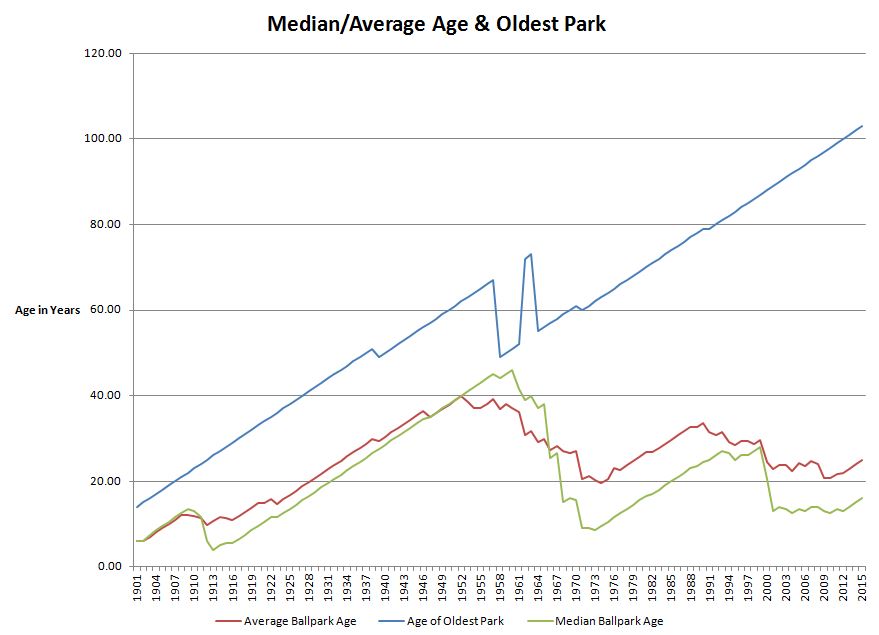
So what I set out to see is just how long ballparks have traditionally lasted.  The results are below, and come with a few notes

  • I utilized Baseballreference.com for the stadium data
  • Ages are my best possible guess – in some cases, the ages can be disputed
    • Was the Yankee Stadium that was replaced in 2009 built in 1923, or 1975?  I have labeled it as built in 1923. as that seems to be the general consensus, but some would regard it as a new ballpark,  Similarly, I did not attempt to adjust the age of parks like the Polo Grounds which underwent various renovations or upgrades over the years.
    • Some ballparks are simply really hard to determine an “opening date” for in the early years.  Baseball in the early part of the 20th Century was still a game in near constant upheaval and development, so exact dates, and when one version of a park replaced another is not a perfect science (or at least not one perfected by me).

Age of ParksAs you can see, there are a couple of key era’s in the age of stadiums.

  • The Early Years – with baseball still finding itself and coalescing into the modern game, teams changes homes frequently – moving from location to location and generally upgrading their facilities over time.  This, combined with the infancy of the League itself kept the average age low.  During these years, and well into the 1930’s, the game’s oldest park was the Baker Bowl in Philadelphia – built in 1887, and home to the Phillies until 1938.
  • The Golden Age – as baseball’s popularity expanded, so did its ballparks,  Many teams outgrew their turn-of-the century fields and constructed massive modern stadium to accommodate larger crowds and modern amenities.  These parks would last through World War II and baseball’s westward expansion.  From 1938, and updated Polo Grounds would hold the title of the game’s oldest park.  These parks were built to last, and that, combined with a lack of team movement, let to steadily increasing ages of stadiums.
  • Expansion – between the westward journey’s of the Giants, Dodgers, Twins and A’s…new franchises in Washington, Los Angeles, Houston, New York, Kansas City, Seattle (then Milwaukee), Montreal and San Diego, a bevy of new stadiums entered the league.  Teams quickly outgrew temporary homes (San Francisco and Houston) or sought purpose-built parks (LA).  This era also saw the close of the Golden Age, with cookie cutter, multipurpose ballparks starting to arrive on the scene, as multi-purpose parks sprang up in Atlanta, St. Louis, Baltimore, Cincinnati and other places.  While these ballparks had plenty of warts, they teamed with expansion to drive down the average age of parks.  Late entries into the same category were Toronto and Seattle, where the Skydome and Kingdome at least added some novelty to the otherwise drab stadium landscape.  with all of the movement from the 1950s through the 80’s, a number of fields held the title of Oldest Park following the Giants abandonment of the Polo Grounds:
    • Shibe Park in Philadelphia until 1970 when it was each replaced by the Vet.  Sportman’s Park (renamed Busch Stadium in 1953) shared the honor with Shibe Park until 1965.
    • A re-opened Polo Grounds in 1962 and ’63 as the Mets awaited Shea Stadium (a park I always disliked in comparison to Yankee Stadium, but given the other parks of the era, at least they threw some color onto the outside of the stadium).
    • Old Comiskey park took over the lead until its replacement in 1991.
  • Modern Expansion and the Retroparks.  The early nineties saw an explosion of new ballparks.  By my count the 89 years between 1901 and 1989, 39 new parks were built – a little more than 1 every two years.  22 have been built in the 26 years since – a little less than a new park every year.  Following the completion of the Skydome in 1989 and Comiskey Park (US Cellular Field) in 1991, designers took a radical leap backward with the opening of Camden Yards. The park, who example was replicated many times in the years since, placed an emphasis on a unique physical structure, minimized distance between the field and fans, and other features to distinguish the park from all those of the previous decades, while calling to mind the previous era’s of baseball’s history.  More recently, these designs have been further adapted in the mold of the New Yankee Stadium (which has its own share of criticisms) to include the Total Fan Experience, with high end dining options and a focus on Luxury Suites and other high-revenue seating.  The old folks of this age are hold overs from the classic era – Tiger Stadium until its replacement in 1999, and Fenway Park to this day.  Wrigley Field follows a close second, but in order for their respective teams to remain competitive (and to stave off efforts at replacing the two parks), numerous renovations have taken place to keep them modern and up to fan’s expectations.

All of that is great, but doesn’t really answer the question.  Certainly the average age of parks has decreased (in general) since the late 80’s and early 90’s, but this has been influenced by expansion as well, not just the replacement of existing parks.  With that in mind, I also took a look at the average age of parks as they were replaced, broken down by decade:

  • 1901-1910: 11 Years
  • 1911-1920: 12 Years
  • 1921-1930: 32 Years (Yankee Stadium “replacing” The Polo Grounds was the only new ballpark.
  • 1931-1940, and 1941-1950: no new ballparks, I guess a Depression and World War have a way of refocusing priorities.
  • 1951-1960: 32 Years
  • 1961-1970: 32 Years (includes the Colt .45’s 2 year stay in a temporary ballpark while the Astrodome was build – without this, the average is 42 Years)
  • 1971-1980: 39 Years
  • 1981-1990: 27 Years
  • 1991-2000: 48 Years
  • 2001-2010: 40 Years
  • 2011-2015: 24 Years (Marlins Park)

So, still a bit of a mixed bag.  The ’50’s and ’60’s building spree wiped out a combination of 1920’s era parks, and minor league parks and other facilities being used as temporary homes for new teams and newly moved franchises.  The ’90s and beyond age seems to be much older, but this is also influenced by the replacement of some classic parks (Comiskey, Tiger Stadium, and Yankee Stadium.)

A better way to look at this might be to look more directly at the parks in question from each age – a separate post specifically looking at the service age of those cookie cutters of the ’60’s and ’70’s is probably the way to go, and where I’ll look next.  That will have to wait until next time though, since this post turned out a lot longer than intented, and I’ve probably lost half my readers before I even got any.

See anything I missed or miscalculated?  Let me know in the comments, along with any questions or ideas for my next rounds of investigation.

Blog to be Named Later

Welcome to the site.  I’ve been watching, following, and working in baseball for the past 30 years.  While my professional ambitions in the sport have been sidelined for the time being, my passion for the sport remains.  I’ve been a die hard Yankees fan my entire life and consider myself a student of the game.  While my Yankee leanings certainly will color the content of this blog, it won’t be the sole focused, and I hope the commentary on events around the baseball universe will be fair and unbiased…I am sure someone will be happy to point out my failings in that regard if I show a little too much favoritism.

Along with a look at current news and rumors, I’ll take a swing at some research topics and interesting questions as they relate to the game.  One of the inspirations for this page is the what if? blog.  If your not familiar with the blog (or book), its definitely suggested reading.  Along the same lines as what if?, I’ll be happy to try and tackle any baseball related questions and research that might be out there, so please feel free to submit them.

So as 2015 gets on a roll and the snow comes down, my mind is on baseball.  Hope you enjoy the ride.