First on tap is a question that has been lingering for some time. The Tampa Bay Rays started play in 1998, and moved into Tropicana Field, which was constructed specifically to attract a Major League team to St. Petersburg. Officials in the area tried to entice the White Sox to leave Chicago, but a deal was reached to replace Comiskey Park, and the Sox stayed put.
Despite the failure, construction (which began in 1986) was completed in 1990 at a cost of $130 Million. Efforts to capture one of the two expansion teams in 1993 fell flat, as did attempts to lure the Giants and Mariners to the area.
In 1991, the Dome finally found use, as the Arena Football League Storm made the facility their home. They were joined by the NHL’s Tampa Bay Lightning 2 years later. Finally, in 1995, MLB awarded the Tampa Bay area a franchise, with the Devil Rays slated to join the league in 1998, To facilitate the move, the Lightning and Storm moved to the Ice Palace in downtown Tampa, and a renovation of the renamed Tropicana Field was undertaken. This remodel cost another $70 Million – driving the cost of a barely used facility to $200 Million before the Devil Rays ever took the field.
Over the next several seasons, more and more money has been invested to improve the stadium, but despite these, the field (one of the smallest by attendance in the league) receives near constant criticism – ranging from the atmosphere and amenities to location of the park itself. These negatives, along with a decade of dismal play to start their existence have kept the Rays attendance figures near the bottom of the league for much of their history, and have led to calls for the team to replace the stadium (and pressure from the ownership group to move.
What inspired me to look into this was the idea that a ballpark less than 25 years old (less than 20 when I first thought about it years ago) could be obsolete was absurd…parks like Tiger Stadium, Wrigley Field, Fenway Park, and Yankee Stadium lasted for decades, not years, what changed?
A similar situation exists in Atlanta, where the team is fleeing downtown Atlanta and Turner field for a suburban ballpark more easily accessible to the team’s fan base. In both cases, the prime concern seems to be location, but both also site the facilities themselves as inadequate to the expectations of fans.
So what I set out to see is just how long ballparks have traditionally lasted. The results are below, and come with a few notes
- I utilized Baseballreference.com for the stadium data
- Ages are my best possible guess – in some cases, the ages can be disputed
- Was the Yankee Stadium that was replaced in 2009 built in 1923, or 1975? I have labeled it as built in 1923. as that seems to be the general consensus, but some would regard it as a new ballpark, Similarly, I did not attempt to adjust the age of parks like the Polo Grounds which underwent various renovations or upgrades over the years.
- Some ballparks are simply really hard to determine an “opening date” for in the early years. Baseball in the early part of the 20th Century was still a game in near constant upheaval and development, so exact dates, and when one version of a park replaced another is not a perfect science (or at least not one perfected by me).
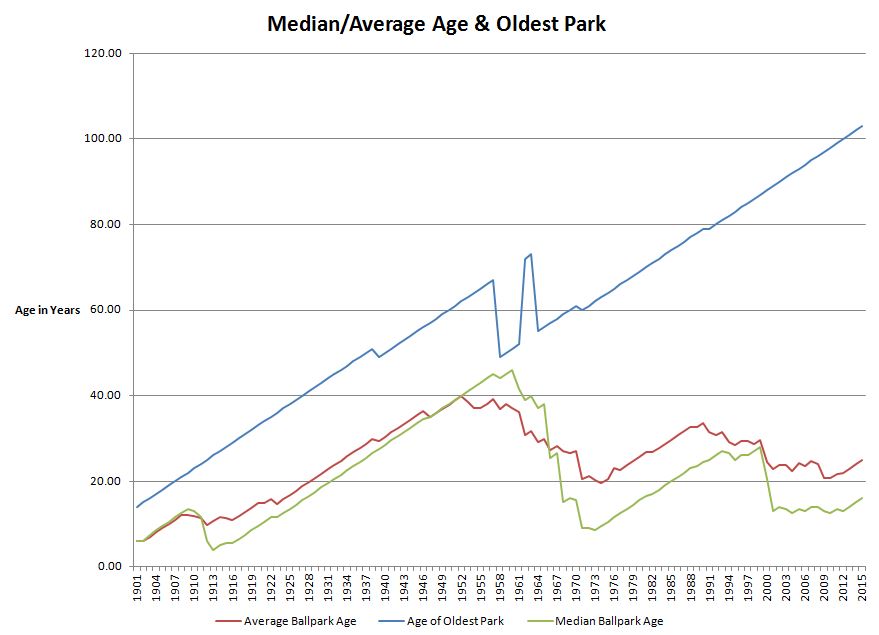 As you can see, there are a couple of key era’s in the age of stadiums.
- The Early Years – with baseball still finding itself and coalescing into the modern game, teams changes homes frequently – moving from location to location and generally upgrading their facilities over time. This, combined with the infancy of the League itself kept the average age low. During these years, and well into the 1930’s, the game’s oldest park was the Baker Bowl in Philadelphia – built in 1887, and home to the Phillies until 1938.
- The Golden Age – as baseball’s popularity expanded, so did its ballparks, Many teams outgrew their turn-of-the century fields and constructed massive modern stadium to accommodate larger crowds and modern amenities. These parks would last through World War II and baseball’s westward expansion. From 1938, and updated Polo Grounds would hold the title of the game’s oldest park. These parks were built to last, and that, combined with a lack of team movement, let to steadily increasing ages of stadiums.
- Expansion – between the westward journey’s of the Giants, Dodgers, Twins and A’s…new franchises in Washington, Los Angeles, Houston, New York, Kansas City, Seattle (then Milwaukee), Montreal and San Diego, a bevy of new stadiums entered the league. Teams quickly outgrew temporary homes (San Francisco and Houston) or sought purpose-built parks (LA). This era also saw the close of the Golden Age, with cookie cutter, multipurpose ballparks starting to arrive on the scene, as multi-purpose parks sprang up in Atlanta, St. Louis, Baltimore, Cincinnati and other places. While these ballparks had plenty of warts, they teamed with expansion to drive down the average age of parks. Late entries into the same category were Toronto and Seattle, where the Skydome and Kingdome at least added some novelty to the otherwise drab stadium landscape. with all of the movement from the 1950s through the 80’s, a number of fields held the title of Oldest Park following the Giants abandonment of the Polo Grounds:
- Shibe Park in Philadelphia until 1970 when it was each replaced by the Vet. Sportman’s Park (renamed Busch Stadium in 1953) shared the honor with Shibe Park until 1965.
- A re-opened Polo Grounds in 1962 and ’63 as the Mets awaited Shea Stadium (a park I always disliked in comparison to Yankee Stadium, but given the other parks of the era, at least they threw some color onto the outside of the stadium).
- Old Comiskey park took over the lead until its replacement in 1991.
- Modern Expansion and the Retroparks. The early nineties saw an explosion of new ballparks. By my count the 89 years between 1901 and 1989, 39 new parks were built – a little more than 1 every two years. 22 have been built in the 26 years since – a little less than a new park every year. Following the completion of the Skydome in 1989 and Comiskey Park (US Cellular Field) in 1991, designers took a radical leap backward with the opening of Camden Yards. The park, who example was replicated many times in the years since, placed an emphasis on a unique physical structure, minimized distance between the field and fans, and other features to distinguish the park from all those of the previous decades, while calling to mind the previous era’s of baseball’s history. More recently, these designs have been further adapted in the mold of the New Yankee Stadium (which has its own share of criticisms) to include the Total Fan Experience, with high end dining options and a focus on Luxury Suites and other high-revenue seating. The old folks of this age are hold overs from the classic era – Tiger Stadium until its replacement in 1999, and Fenway Park to this day. Wrigley Field follows a close second, but in order for their respective teams to remain competitive (and to stave off efforts at replacing the two parks), numerous renovations have taken place to keep them modern and up to fan’s expectations.
All of that is great, but doesn’t really answer the question. Certainly the average age of parks has decreased (in general) since the late 80’s and early 90’s, but this has been influenced by expansion as well, not just the replacement of existing parks. With that in mind, I also took a look at the average age of parks as they were replaced, broken down by decade:
- 1901-1910: 11 Years
- 1911-1920: 12 Years
- 1921-1930: 32 Years (Yankee Stadium “replacing” The Polo Grounds was the only new ballpark.
- 1931-1940, and 1941-1950: no new ballparks, I guess a Depression and World War have a way of refocusing priorities.
- 1951-1960: 32 Years
- 1961-1970: 32 Years (includes the Colt .45’s 2 year stay in a temporary ballpark while the Astrodome was build – without this, the average is 42 Years)
- 1971-1980: 39 Years
- 1981-1990: 27 Years
- 1991-2000: 48 Years
- 2001-2010: 40 Years
- 2011-2015: 24 Years (Marlins Park)
So, still a bit of a mixed bag. The ’50’s and ’60’s building spree wiped out a combination of 1920’s era parks, and minor league parks and other facilities being used as temporary homes for new teams and newly moved franchises. The ’90s and beyond age seems to be much older, but this is also influenced by the replacement of some classic parks (Comiskey, Tiger Stadium, and Yankee Stadium.)
A better way to look at this might be to look more directly at the parks in question from each age – a separate post specifically looking at the service age of those cookie cutters of the ’60’s and ’70’s is probably the way to go, and where I’ll look next. That will have to wait until next time though, since this post turned out a lot longer than intented, and I’ve probably lost half my readers before I even got any.
See anything I missed or miscalculated? Let me know in the comments, along with any questions or ideas for my next rounds of investigation.
 Blog to be Named Later